Sri Gurubhyo Namaha
The sacred tradition of Guru-Shishya Parampara
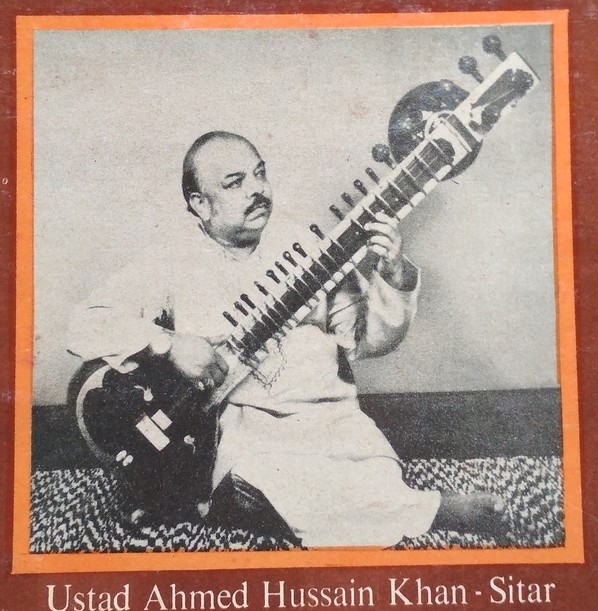
Ustad Ahmed Hussain Khan — Sitar
Sitar Nawaz Ustad Ahmed Hussain Khan hails from the ancient and famous Mian Achpal and Senia Gharana, which has made great contributions to the preservation, promotion, and development of the high traditions of Hindustani Classical Music.
He achieved such high perfection and unsurpassed mastery on the Sitar that he could make it sing, cry, wail, and even talk — "The blood of music in his veins."
Ustad ji had his initial training from his father Ustad Bundu Khan Saheb and later studied under Ustad Rahimat Khan Saheb and Ustad Habib Khan Sahib. He became an exponent of the special techniques of Raza Khani, Maseet Khani, and Seni Bhaj. Originally from Pune, he moved to Madras and served as a teaching faculty at the Bharatiya Vidya Bhavan, Madras, training many aspirants.
Preserving and passing on the tradition of the Sitar
We offer one-on-one personalised Sitar instruction, designed to cater to each student's individual learning pace and musical goals. Classes are available both online and offline in Bangalore and Chennai, ensuring flexibility and accessibility.
Learning the sitar under Guruji is not a course to be completed but a journey to be lived — rooted in the sacred guru-shishya parampara (teacher-student tradition). These questions and answers are meant to help you understand what this journey involves, whether you are just beginning to feel drawn to the sitar or already several years into your practice.
Starting your journey with the sitar
Hindustani classical music is the classical music tradition of North India, with roots stretching back thousands of years. It is built on two foundational pillars: raga (melodic framework) and tala (rhythmic cycle). Unlike film music or folk traditions, Hindustani classical is deeply improvisational — a single raga can be explored for an hour, with the artist creating spontaneously within its rules.
Its counterpart, Carnatic music, is the classical tradition of South India. While both share ancient origins, they differ in approach: Hindustani music emphasizes alaap (slow, meditative exploration) and improvisation, while Carnatic music is more composition-driven. Sri Sivaramakrishna is uniquely proficient in both traditions on the sitar, which is exceedingly rare.
The sitar is a plucked string instrument with a long neck and a gourd resonator. It typically has 18–21 strings, including main playing strings, rhythmic drone strings (chikari), and sympathetic strings (taraf) that vibrate in resonance and give the sitar its signature shimmer. The instrument is capable of extraordinary expressiveness through techniques like meend (string bending), which allows continuous gliding between notes — something unique to Indian stringed instruments.
Among Indian classical instruments, the sitar occupies a place of deep reverence. Its tonal range spans nearly three octaves, and in the hands of a skilled artist, it can evoke the entire spectrum of human emotions. The instrument demands both physical stamina and meditative focus, which is what makes learning it such a transformative experience.
A gharana is a lineage or school of music, passed down from guru to shishya (teacher to student) over generations. Each gharana has its own distinctive style, techniques, and repertoire. Being part of a gharana means inheriting a living tradition — not merely learning notes, but absorbing an entire philosophy of music.
Sri Sivaramakrishna belongs to the Mian Achpal and Senia Gharana, an ancient and illustrious lineage with profound contributions to Hindustani classical music. His guru was the late Ustad Ahmed Hussain Khan, who trained under Ustad Bundu Khan Saheb and was an exponent of special techniques including Raza Khani, Maseet Khani, and Seni Bhaj. The lineage traces further back through Ustad Rahimat Khan (1863–1954) — who is credited with adding the kharaj-shadaj string to the sitar, essentially inventing the string setup used on most sitars today — to the legendary beenkar Bande Ali Khan.
There is no strict minimum age. Sri Sivaramakrishna has taught students as young as seven years old. That said, teaching young children is inherently more challenging — their attention spans are shorter, their hands are smaller, and grasping abstract musical concepts takes more time. Both the child and the parents need to understand and accept this reality.
For younger students, the approach is adapted: smaller sitars are used, lessons are structured differently, and progress is measured at the child's own pace. What matters most is that the child shows genuine interest in the instrument, not that they were enrolled by a parent who thinks it would be a good hobby. If the spark is there, Guruji will nurture it with great patience.
No prior musical training is necessary. Complete beginners are welcome, and Guruji will build your musical foundation from scratch — starting with the very basics of sitting posture, holding the instrument, and producing your first notes. Everyone begins at the beginning.
That said, if you do come with a musical background — whether in Carnatic vocals, Western classical, guitar, or any other tradition — that training will only help. Musical sensibility, a trained ear, and rhythmic awareness are all transferable gifts. The one essential requirement is that you come with genuine intent to learn this form of music earnestly, not to pick up a few basics to incorporate into another genre. That approach would be disrespectful to the tradition.
The first few months are about building a solid physical and musical foundation. You will learn the correct sitting posture (which matters immensely for long-term comfort and technique), how to hold the sitar, and the right-hand stroke technique using the mizrab (wire plectrum). Simultaneously, you will begin basic paltas (finger exercises) and sargam patterns to develop coordination between both hands.
Be patient with yourself during this period. The sitar is physically demanding, and building the finger strength and muscle memory takes time. Every term will be explained — alaap, jod, jhala, meend — at length, with enormous patience, until you truly grasp them. Your only job in these early months is to show up prepared and practice sincerely.
A minimum of 45 minutes of focused daily practice is expected. This is not a suggestion — it is a genuine requirement for meaningful progress. The sitar demands regular physical engagement; your fingers need to develop strength and calluses, your ears need to internalize the microtonal intervals, and your body needs to become comfortable with the posture. None of this happens without daily practice.
Coming to a lesson unprepared is not acceptable. If life circumstances have prevented you from practising in a given week, the respectful thing to do is to inform your teacher beforehand and ask if you can have a few extra days. This shows regard for his time and for the process. He will always be understanding when the reason is genuine — what he will not accept is a pattern of casual neglect.
You will need a sitar to practise on, but please do not buy one on your own. This is one of the most important pieces of advice we can offer. Many enthusiastic beginners rush out and purchase expensive sitars after their very first class, only to lose interest a few months later. The sitar then sits in a corner gathering dust — which is disrespectful to the instrument and to the music it carries.
Instead, consult Sri Sivaramakrishna before making any purchase. He will guide you on the right instrument for your stage of learning. In many cases, there are beginner-level sitars available (sometimes from students who are upgrading) at very reasonable costs. Start modestly, commit to the journey, and upgrade when the time is right. This is a lifelong pursuit, not a kneejerk decision. He will never pressure you to buy an expensive instrument.
Yes, online classes are available and Sri Sivaramakrishna teaches students from all over the world through video calls. Students currently learn from cities across India as well as internationally. While in-person lessons offer the irreplaceable experience of being physically in the presence of your guru, online classes have proven remarkably effective for committed students.
A stable internet connection and a quiet space are all you need. The teaching approach is adapted for the online medium, and many students have made excellent progress this way. For students in Bangalore or Chennai, in-person classes are also an option. Regardless of the mode, what matters most is the sincerity of the student.
Please contact us directly for details about class schedules and fees. Every student's situation is different, and Guruji believes in discussing this personally rather than publishing a price list. The academy's purpose is to keep the tradition of sitar music alive, not to operate as a commercial enterprise.
You can reach out through the contact section on sitarsiva.in or use the inquiry form on the website. We will be happy to discuss arrangements that work for your situation.
Trial classes are available for students who already have some prior musical background — for example, if you have trained in Carnatic vocal music, played another instrument, or have some exposure to Indian classical music. In such cases, a trial session helps both you and your teacher assess the fit.
For complete beginners, however, a trial class is not the right approach. Learning the sitar takes time even to understand the basics, and a single session cannot meaningfully demonstrate what the journey will be like. If you are a total beginner, the better path is to have an honest conversation with us about your interest and commitment, and then begin with the understanding that the first few weeks are themselves an extended introduction.
The guru-shishya parampara is the ancient Indian tradition of knowledge being transmitted directly from teacher to student through a deeply personal, often lifelong relationship. It is fundamentally different from a modern classroom or a coaching centre. The guru does not merely teach techniques; he transmits a living art, shaped by decades of his own practice and the wisdom he received from his own guru.
In this tradition, the relationship is built on mutual respect, trust, and sincerity. The student offers dedication and humility; the guru offers his knowledge, time, and genuine care for the student's growth. It is not a transaction. Guruji teaches because he sees it as seva (selfless service) to the musical tradition he inherited — keeping the flame alive for the next generation. Understanding this context will help you appreciate why learning in this tradition is different from enrolling in a typical music class.
The curriculum is solidly rooted in Hindustani classical music. This is the primary tradition of the sitar, and it is where every student's journey begins and deepens. You will learn ragas, talas, compositions, and the art of improvisation in the Hindustani idiom.
Sri Sivaramakrishna is one of the rare sitarists equally proficient in the Carnatic tradition, and for students who show interest and readiness, he will introduce Carnatic compositions as well. However, the path of learning is determined by your teacher based on each student's aptitude and progress — students do not get to choose their curriculum the way one might pick courses at a university. Trust the process and trust your guru.
Class frequency is discussed individually with each student, as it depends on factors like your level, availability, and how quickly you are progressing. Most students have one lesson per week, which provides enough material to work on between sessions. Each lesson is typically one hour long.
A typical class begins with Sri Sivaramakrishna reviewing what was assigned previously — listening to you play, correcting technique, and refining your understanding. He then introduces new material: perhaps a new palta, a new section of a raga, or a composition. He explains musical concepts with extraordinary patience, often illustrating them through his own playing. The lesson ends with clear instructions on what to practise and how.
There are no rigid rules about rescheduling. Life happens — illness, travel, family obligations — and Guruji understands this. If your reasons are genuine and you have otherwise been putting in sincere effort, he will be tolerant and accommodating. Simply inform him as early as possible, and a mutually convenient time can usually be found.
What will not be tolerated is a pattern of regular, casual cancellations. If a student frequently misses classes without genuine reason, it signals a lack of commitment — and in such cases, the student may eventually be asked to discontinue. This is not harshness; it is respect for the tradition and for the time that could be given to a more dedicated student.
Yes, students are welcome to record their lessons for personal learning purposes. Audio or video recordings can be immensely helpful for reviewing what was taught, practising along, and catching nuances you might have missed during the session. Many students find this invaluable, especially for remembering the exact way a particular passage or technique was demonstrated.
However, these recordings must remain strictly private. Do not upload lesson recordings to YouTube, Instagram, or any social media platform. The content of these lessons belongs to the guru-shishya relationship and is meant for your own growth, not for public display or gaining attention online.
Sri Sivaramakrishna is fluent in English, Hindi, Telugu, Tamil, and Kannada, and classes are conducted in whichever language the student is most comfortable with. For international students, classes are typically in English. Musical terms are introduced in their original Hindi or Sanskrit forms, but always with thorough explanations — he will never assume you already know what a term means.
Language is never a barrier at the academy. Music itself is a universal language, and the academy has welcomed students from diverse linguistic and cultural backgrounds with equal warmth.
The academy does not currently conduct formal assessments or issue certificates. The focus is on genuine, deep learning rather than credentials. This is not a crash course or an exam-preparation centre — it is an immersion into a musical tradition that unfolds over years.
That said, if a student wishes to appear for examinations conducted by institutions like Gandharva Mahavidyalaya or similar bodies, Guruji will gladly help with both theoretical and practical preparation. Just know that this should not be the primary motivation for joining. The academy does not teach with the intention for students to gain popularity through reality shows or showmanship — the art runs much deeper than that.
Learning the sitar at the academy is a meaningful undertaking, not a casual hobby to be picked up and discarded on a whim. This does not mean you need to aspire to become a professional performer — not at all. Many students learn purely for the joy and fulfilment of it. But the expectation is that whatever time you do dedicate, you do it with sincerity and regularity.
Guruji has infinite patience for students who are genuinely trying but struggling. He has zero tolerance for a casual, careless attitude. If you commit to 45 minutes of daily practice and attend your lessons prepared, you will find him to be one of the most supportive and generous teachers you have ever encountered. The effort has to come from you; the guidance will always be there.
Absolutely. Any prior musical training is an asset. Carnatic vocalists bring an understanding of raga and tala; Western classical musicians bring disciplined practice habits and reading ability; guitarists bring left-hand dexterity and familiarity with fretted instruments. All of these backgrounds will accelerate certain aspects of your sitar learning.
The one important caveat: you must come with the genuine intention of learning sitar and Hindustani classical music on its own terms. If the purpose is to pick up a few sitar techniques to take back to your existing genre — to add an "exotic flavour" to your guitar playing or fusion project — that would be a misuse of the tradition and your teacher's time. Come with respect for the art form, and it will enrich every other musical pursuit you have, naturally and organically.
B. Sivaramakrishna Rao is not primarily a teacher — he is a performing artist of international stature who has given concerts in over fifteen countries, including the USA, France, Germany, Switzerland, Australia, China, and Sri Lanka. He has over twenty albums on platforms like Spotify, Apple Music, Amazon, and JioSaavn. He was awarded "Child Prodigy of the Year" in 1990 by the Governor of Tamil Nadu and received the Madhura Murali Puraskar from the legendary Dr. M. Balamuralikrishna.
He teaches not as a vocation, but out of deep love for the tradition and a sense of responsibility to pass it forward. When you learn from him, you are receiving knowledge that flows directly from an unbroken lineage stretching back centuries through the Mian Achpal and Senia Gharana. You can explore his music and career at sitarsiva.in.
Deepening your practice and understanding
After the initial phase of building physical technique and learning your first few ragas, the intermediate stage is where the real depth of Indian classical music begins to reveal itself. You move from playing compositions note-by-note to understanding their inner structure — why a raga moves the way it does, how phrases create emotional colour, and how rhythm and melody intertwine.
This is also the stage where Sri Sivaramakrishna begins to share deeper insights — the personality of each raga, the emotional landscape it inhabits, the time of day it is meant to evoke. These teachings go far beyond technique into the very heart of the music.
As a beginner, you learn a raga's basic ascending and descending scales and a few compositions. At the intermediate level, you begin to explore each raga's full personality: its characteristic phrases (pakad), the notes that deserve special emphasis (vadi and samvadi), the ornamentations that bring it to life, and how it differs from similar ragas. Two ragas may share the same set of notes yet sound entirely different based on how those notes are approached and treated.
Sri Sivaramakrishna will teach you to hear these subtleties, not just play them. You will begin to understand why Raga Yaman feels serene and devotional while Raga Marwa, which shares many notes, evokes a restless, searching quality. This deeper listening is what transforms a student from someone who plays sitar into someone who truly makes music.
Performance readiness is entirely your teacher's call, and it varies greatly from student to student. Some students may be comfortable playing at intimate gatherings within a few years; a formal concert setting demands far more. The key is to not rush toward performing. In the tradition, performing before one is truly ready can actually set back a student's development by encouraging superficial playing over deep understanding.
When the time is right, Guruji will encourage and support you. He has helped students prepare for performances and recordings when they are genuinely ready. Trust the timeline — even legendary maestros considered themselves lifelong students and were cautious about when they performed.
Meend is the technique of bending the string sideways along the fret to glide smoothly between notes. It is one of the sitar's most distinctive and beautiful capabilities — allowing the player to produce continuous, vocal-like slides that no keyboard instrument can replicate. A well-executed meend can span several notes in a single, unbroken, singing movement.
Developing good meend technique takes considerable time and finger strength. At the intermediate level, you will work extensively on this skill, gradually extending your range from two-note slides to broader, more expressive ones spanning four or even five notes. Sri Sivaramakrishna's own meend technique, inherited from the Mian Achpal and Senia Gharana, is particularly nuanced, and he will guide you with great detail and patience as you develop this essential dimension of your playing.
As a beginner, you learn to keep basic time and play within a tala (rhythmic cycle). At the intermediate level, your relationship with rhythm deepens considerably. You begin to understand how to navigate complex rhythmic patterns, how to resolve phrases elegantly at the sam (the first beat of the cycle), and how laya (tempo) interacts with the raga's emotional arc.
You will be introduced to compositions in different talas — beyond the common Teentaal (16 beats), you may explore Jhaptaal (10 beats), Ektaal (12 beats), Rupak (7 beats), and others. The goal is not just to count beats but to feel the rhythm internally, so that the tala becomes a living pulse rather than a metronome you are chasing. This internalization of laya is what separates a competent student from a truly musical one.
These are the three stages of the traditional Hindustani instrumental recital format. Alaap is the slow, meditative unfolding of a raga without rhythmic accompaniment — pure melody exploring the raga's character note by note. Jod introduces a gentle rhythmic pulse while continuing the melodic exploration. Jhala is the climactic phase, with rapid, rhythmic strumming of the drone strings creating an exhilarating crescendo.
You will be introduced to alaap concepts relatively early, but true alaap playing — where you can sustain a raga's mood for an extended period through improvisation — develops significantly at the intermediate and advanced levels. Jod and jhala require substantial right-hand technique and typically come into focus after a year or more of foundational work. Each element will be introduced when you are ready, layering complexity as your skills grow.
As your repertoire grows and the complexity of what you are learning increases, you will naturally find that 45 minutes begins to feel insufficient. Many intermediate students practise for an hour to an hour and a half, and more serious students devote even longer. The key is consistency and quality — an hour of focused, mindful practice is worth far more than two hours of mechanical repetition.
At this level, practice should include dedicated time for different elements: paltas and technical exercises to maintain and build dexterity, alaap practice for each raga you are working on, gat practice with attention to rhythm, and revision of previously learned material. Sri Sivaramakrishna will guide you on how to structure your practice sessions effectively. The sitar rewards those who show up every day, even when progress feels slow.
The right time to upgrade is when your skill level has genuinely outgrown your current instrument — and this is a conversation to have with Sri Sivaramakrishna, not a decision to make based on impulse or aspiration. A better sitar will not make you a better player, but at a certain point, a beginner instrument may genuinely limit what you can express, particularly in the subtlety of meend and the resonance of sustained notes.
When the time comes, he will advise you on what to look for: the quality of the wood, the resonance of the gourd (tumba), the action of the frets, the quality of the jawari (bridge filing that creates the sitar's characteristic buzzing timbre). His guidance here is invaluable and will save you from expensive mistakes. A good sitar is a companion for decades — it deserves careful, informed selection.
Yes. Sri Sivaramakrishna actively helps students with recordings when they are ready. He has deep experience in the recording process — having produced over twenty albums himself and worked with professional studios extensively. He can guide you on everything from selecting the right ragas and compositions to the technical aspects of getting good sitar sound on a recording.
These recordings are meant as milestones in your personal journey — a way to document your progress and share your music with family and close circles. If recordings are eventually shared publicly, they should represent your genuine level of musicianship and be done with your teacher's knowledge and blessing. The academy does not promote student recordings for social media popularity or viral attention.
Improvisation is the heart of Hindustani classical music, but it does not emerge suddenly — it grows organically from deep familiarity with ragas, compositions, and the idioms of the instrument. In the early years, improvisation is guided: your teacher may ask you to create simple variations on a phrase or explore a small section of a raga on your own, and then refine your attempts.
True, sustained improvisation — where you can unfold a raga spontaneously for an extended period — typically begins to emerge after several years of dedicated study. It requires not just technical fluency but musical maturity: knowing what to play, when to hold back, how to build tension and release, and how to stay true to the raga's character while adding your own voice. This is the art of a lifetime, and even great masters considered their improvisational abilities to be perpetually evolving.
Students with a Carnatic background often have a significant advantage: a well-trained ear for swaras (notes), an understanding of tala, and exposure to raga concepts. These are genuinely transferable skills. However, the Hindustani approach to raga presentation is quite different — more emphasis on alaap (slow, free-flowing exploration), a different set of ragas (though some overlap), different ornamentation patterns, and a distinct aesthetic sensibility.
Sri Sivaramakrishna, being proficient in both traditions, is uniquely equipped to bridge this gap. He understands the Carnatic framework you come from and can draw parallels while teaching you the Hindustani idiom. Over time, students from Carnatic backgrounds often find that their sitar playing enriches their understanding of Carnatic music as well — the two traditions illuminate each other beautifully when studied with depth and sincerity.
By the intermediate stage, the initial discomforts — sore fingertips, back ache from unfamiliar posture, forearm fatigue — should have largely resolved as your body has adapted. The new challenges are subtler: developing the finger strength for extended meend across multiple frets, building endurance for longer practice and performance sessions, and maintaining relaxation in your hands and shoulders even during demanding passages.
Tension is the enemy of good sitar playing. If you notice persistent pain or stiffness, discuss it with your teacher — often the root cause is a postural issue or a tension habit that can be corrected. Sri Sivaramakrishna pays careful attention to ergonomics and will adjust your technique to prevent strain. Many of these physical refinements, though they seem minor, have profound effects on the quality and expressiveness of your sound.
The academy does not hold institutionally mandated annual recitals or concerts. This is a deliberate choice. Forced performances on a calendar schedule can push students to play publicly before they are ready, or create anxiety that detracts from the learning process. Music should emerge from readiness and joy, not from obligation.
That said, student workshops and informal gatherings do happen when students themselves take the initiative to organise them. Sri Sivaramakrishna is supportive of such efforts and will help students prepare. He also assists individual students with performances and recordings when they reach the appropriate level. The key difference is that these opportunities arise organically rather than being imposed by a schedule.
The sitar is a delicate wooden instrument that requires respectful care. Keep it in a padded case when not in use, away from extreme heat, cold, or humidity. In dry climates or air-conditioned rooms, the wood can crack, so be mindful of sudden environmental changes. Never lean the sitar against a wall uncased — falls are the most common cause of damage.
Strings need periodic replacement as they lose their brightness and elasticity. The jawari (the curved bridge surface that creates the sitar's characteristic buzzing resonance) requires occasional filing by a skilled craftsman to maintain its sound. You will be taught basic maintenance — tuning, string replacement, cleaning — and can guide you to trusted repair specialists when more serious work is needed. Treating your sitar with care is itself a form of respect for the music.
Listening is not a supplement to practice — it is an essential, non-negotiable part of learning Indian classical music. Your ear must absorb the grammar of ragas, the subtleties of phrasing, the way great masters handle tempo and dynamics. This cannot be learned only from exercises and compositions; it must be heard, again and again, from the masters.
Sri Sivaramakrishna will likely recommend specific recordings and performances for you to study. Listen to the great sitarists, but also to vocalists — the human voice is the ultimate reference point for melodic expression in Indian music. Attend live concerts whenever possible; recorded music, however excellent, cannot fully convey the energy and spontaneity of a live performance. Over time, deep listening reshapes how you play, often in ways you cannot consciously articulate.
Completely normal, and in fact, expected. Plateaus are an inherent part of learning any deep art form. In the early months, progress feels rapid because everything is new — you go from producing no sound to playing recognizable melodies in a matter of weeks. As you advance, the improvements become more subtle and internal: a slightly cleaner meend, a deeper understanding of a raga's mood, a more natural sense of rhythm. These gains are real but harder to perceive day to day.
Guruji has guided many students through these periods and understands them well. His advice is almost always the same: maintain your practice, trust the process, and be patient. Sometimes a plateau breaks when you learn a new raga that suddenly makes a previous concept click. Sometimes it breaks when you hear a great performance that inspires you. The only thing that prevents progress is stopping altogether.
In the Hindustani tradition, most ragas are associated with a specific time of day or night, and some with particular seasons or moods. Raga Bhairav is a morning raga, Raga Yaman belongs to the early evening, Raga Malkauns is for the late night. This is not mere convention — it reflects a deep aesthetic philosophy that connects musical expression to the rhythms of nature and human emotion.
As an intermediate student, you will begin to appreciate these associations through experience. When you practise Raga Todi in the morning and truly sink into its meditative, introspective quality, you understand viscerally why it belongs to that time. Sri Sivaramakrishna will share these associations and the reasoning behind them. While modern concert schedules do not always allow for time-appropriate raga performance, understanding and respecting these associations deepens your connection to the music immeasurably.
The honest answer is: you never finish learning. The sitar, and Indian classical music more broadly, is a tradition so vast and deep that even the greatest maestros of our time considered themselves perpetual students. Pandit Ravi Shankar practised until the very last years of his life. This is not meant to discourage you — quite the opposite. It means that there is always something new to discover, always a deeper layer to explore, always a raga you have not yet encountered.
What changes over time is the nature of the journey. In the early years, you are building skills and vocabulary. In the middle years, you are developing musical intelligence and expressiveness. In the later years, the music becomes a form of meditation, a mirror of your inner life. Guruji often says that the sitar is not just an instrument you play — it becomes a lifelong companion. The question is not "how long will it take?" but "am I willing to begin?"
Sri Sivaramakrishna himself has performed and recorded fusion and contemporary music extensively — his projects Ateetam and the Basavaraj Brothers incorporate cross-genre elements with great artistry. So he is certainly not opposed to fusion. However, his strong belief is that fusion without a solid classical foundation is shallow and unconvincing. You cannot meaningfully blend traditions you have not deeply studied.
The classical training must come first and remain the core. Once your understanding of raga, tala, and the sitar's classical vocabulary is strong enough, exploring fusion becomes a creative extension rather than a shortcut. Your teacher will be the best judge of when that point arrives. Many students find that by the time they have sufficient classical depth, their approach to fusion is far more nuanced and respectful than anything they would have produced as beginners trying to mix genres.
Beyond the intermediate level lies a vast, rewarding landscape. Advanced students develop the ability to sustain a full-length raga presentation — from the opening alaap through jod, jhala, and multiple compositions — with genuine musical authority. They learn rare and complex ragas, intricate rhythmic patterns, and the art of engaging in jugalbandi (duet performances) with other instrumentalists. Personal style begins to emerge as the student's own musical personality finds expression within the framework of the tradition.
At the deepest level, the sitar becomes inseparable from the person playing it. Practice becomes meditation, performance becomes offering, and the music becomes a way of seeing the world. This is not poetic exaggeration — ask any serious practitioner and they will tell you that the music has transformed them as human beings. Sri Sivaramakrishna's own journey, spanning decades and fifteen countries, is a living testament to where this path can lead. The invitation is simply to take the next step.
We would be happy to hear from you. Whether you are considering starting your journey or are an existing student with specific questions, please do not hesitate to reach out.
Guruji and the academy team respond to every sincere inquiry.
Get in TouchRaga Shankarabharanam
SRK Academy Student
Words from students and fellow musicians